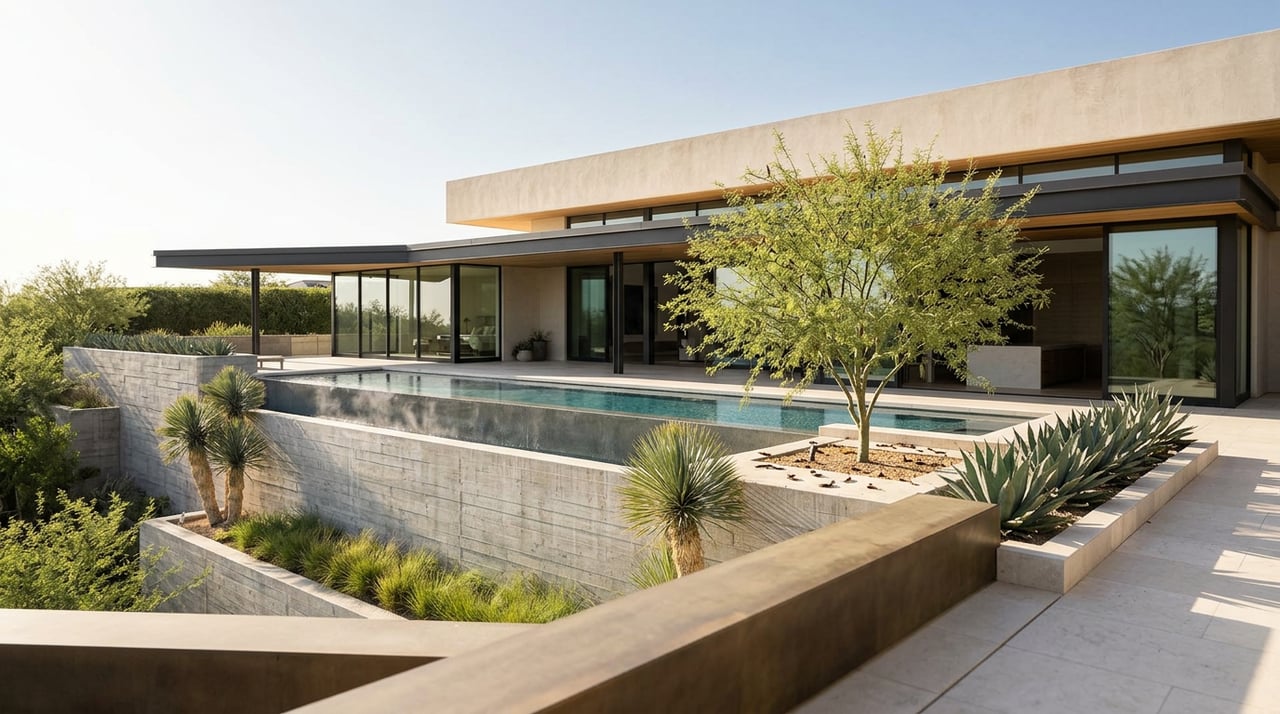
In late March 2026, a minimalist custom home at 10 Sanctuary Peak Court in Ascaya went on the market for $6,195,000. Built by Richie Wu of Enchanted Homes for owner Bill Jaaskela, the 5,601-square-foot house came in around $1,106 a square foot, a price the listing agent flagged as unusually low for the neighborhood, where other homes were trading north of $2,000 a square foot. By mid-July, the same address showed up on an MLS feed at $5,245,000, a repricing of roughly $950,000 in under four months.
Nothing about the house changed in that window. What changed was the number the market was willing to attach to it, and that gap is the whole story of why Ascaya's "median price" is one of the least useful numbers a buyer can lean on.
If you have already toured a portal or two for Ascaya, you have probably seen this confusion firsthand. Pull up one listing feed on a given week and the median list price reads somewhere around $9.7 million. Check a different feed pulling from the same MLS a few weeks later and the median has fallen to under $3 million. Average days on market swings from 115 to nearly 200 depending on which snapshot you catch. None of these numbers are wrong. They are just measuring different things, because Ascaya's neighborhood tag covers three products that behave nothing alike.
The three markets hiding under one median
Ascaya is a 313-lot custom-build community carved into the McCullough Range above Henderson, and at any given moment its active listings are a mix of:
- Raw homesites. The Estate Collection starts around $1 million for lots roughly half an acre and up. The higher Cloud Rock Collection, released in its final phase at 58 lots, runs from about $2 million to $8 million depending on elevation and view corridor.
- Homes under construction or freshly completed. Buyers who purchase a lot work with an approved architect and an architectural-review-board-approved builder, most often Blue Heron, then spend two to three years building before the home ever shows up as a comparable sale.
- A thin resale pool. As of spring 2026, roughly 105 of the 313 lots had completed, occupied homes, with another 35 under active construction. That leaves a resale market built on well under half the community's eventual footprint.
A $1.2 million vacant lot and a $14 million finished estate can both sit under the same "Ascaya" filter on a search site on the same day. When lots make up a larger share of that week's active inventory, the blended median collapses toward the low end. When finished mansions dominate, it spikes. The community isn't getting cheaper or more expensive week to week. The mix of what happens to be listed is just shifting under the hood.
There is a cleaner way to see this. Closed-sales data collected for completed homes only in the first quarter of 2026 put the average sale price at $7.8 million, with a range from $4.1 million to $24 million, and a price-per-square-foot spread of $1,150 to $2,800 that reflects finish quality and view premium rather than location within the gate. That figure, isolated to actual finished houses that actually closed, tells a buyer far more than any active-listing median that mixes in raw land.
Why the build number matters more than the median
Ascaya imposes no mandatory construction timeline, so a buyer can secure a lot and sit on it for years before breaking ground. That flexibility is a selling point, but it also means the "for sale" count at any moment includes lots that will not become comparable sales for a long time, further diluting whatever number a portal spits out.
The build economics tell a more consistent story. A typical lot-and-build path runs roughly $2.1 million for land plus $4.5 million to $8 million in construction costs for a 4,500 to 7,500 square foot home at close to $1,000 a square foot in hard costs, landing a total basis somewhere between $6.6 million and $10.1 million. Against that first-quarter average resale of $7.8 million, well-designed, well-executed builds tend to clear their construction basis by 15 to 25 percent at first resale. Builds with weaker design or a poor view match do not carry the same premium, which is a big part of why the Sanctuary Peak Court repricing happened to a home widely praised for its craftsmanship. Minimalist design is harder to execute and more expensive to build correctly, and the market still needed a price cut to find its buyer.
Lot scarcity plays its own role. When Raiders owner Mark Davis combined four separate lots to build his home, it drew significant attention specifically because assembling multiple parcels removes that inventory from the pool entirely, tightening what remains available at the highest elevations. A handful of moves like that can shift the available Strip-view lot count more than a full quarter of ordinary turnover.
What to ask instead of trusting the median
If you are comparing Ascaya against The Ridges in Summerlin or MacDonald Highlands in Henderson, the median-price comparison you have probably already made on a portal is not comparing like products. The Ridges is a larger, more established community built around Bear's Best golf course with a broader mix of resale inventory and an active school and trail ecosystem tied into the rest of Summerlin. MacDonald Highlands centers on DragonRidge Country Club with a wider range of home styles and a deeper resale bench. Ascaya has neither golf nor a large resale pool. What it offers is elevation, architectural control, and a scarcity story that only makes sense once you know which of the three Ascaya markets you are actually pricing.
Before you anchor to any number you see online, ask your agent three things: is this figure counting raw lots alongside finished homes, is the days-on-market number measuring list-to-close or just the current listing's time at its current price, and how many truly comparable finished homes have closed in the last two quarters, not just listed. In a community with roughly 105 completed homes against 313 total lots, the comparable set for any given price point is small enough that one or two unusual sales can swing a median more than they would in a larger neighborhood.
A few common questions
Is Ascaya's median price actually rising or falling in 2026? The honest answer is that the active-listing medians published across different sites this year have moved in both directions within the same few months, largely because the mix of raw lots versus finished homes on the market changes week to week. The more stable figure is the completed-homes-only average from closed transactions, which sat at $7.8 million for the first quarter of 2026.
Does a lower price per square foot mean a better deal? Not automatically. The Sanctuary Peak Court sale priced well below the community's typical $2,000-plus per square foot ceiling specifically because minimalist architecture is harder to execute, not because the home offered less value. Design intent and view orientation matter more than a raw per-square-foot comparison.
How long does a typical Ascaya purchase take from lot to move-in? Buyers who purchase a lot and build should plan for a two to three year design and construction cycle before the home is livable, which is a meaningful difference from buying an already-finished resale home in a community with deeper inventory.
If you are weighing Ascaya against Summerlin's hillside enclaves or Henderson's other guard-gated communities, the numbers on a portal will only get you partway there. Jill Sells Vegas works these exact comparisons with clients relocating into western Las Vegas and Henderson's luxury tier every week, and can walk you through which Ascaya comps actually apply to the home you are picturing. Let's Connect.